For research organized by topic, see below.
GameDay Project
This research project examines discourse in the coverage of college football, combining my interests in race and college sports. Through analysis of over 118 hours of video data, this study systematically documents a corrosive media landscape. Among other aspects, I examine how announcers characterize athletes and how coverage handles and portrays student athlete activism.
Publications:
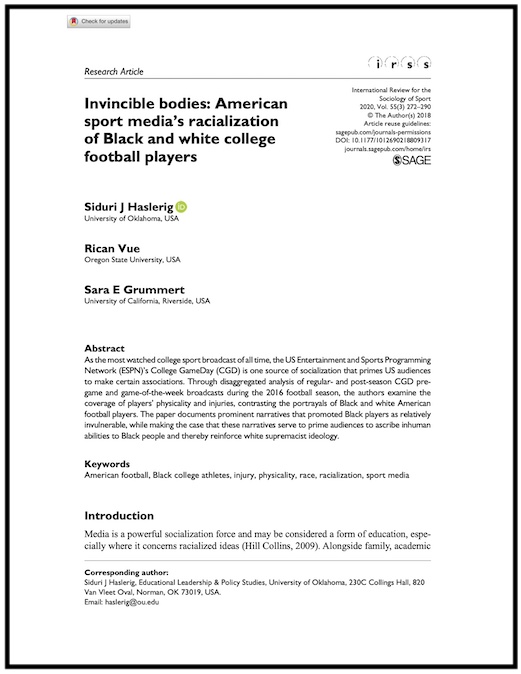 Haslerig, S. J., Vue, R., & Grummert, S. E. (2020). Invincible bodies: American sport media’s racialization of Black and white college football players. International Review for the Sociology of Sport, 55(3), 272-290.
Haslerig, S. J., Grummert, S. E., & Vue, R. (2019). Rationalizing Black death: Sport media’s dehumanizing coverage of Black college football players. In P. Brug, K. Roth and Z. Ritter (eds). Marginality in the Urban Center:The Costs and Challenges of Continued Whiteness in the Americas and Beyond. Springer. [Haslerigetal2019_RationalizingBlackDeath_chapter]
Selected Presentations:
Haslerig, S. J. & Grummert, S. E. (November, 2018). Affective attributions: Commentators’ raced portrayal of emotion in football players. Paper presented at the North American Society for the Sociology of Sport (NASSS),Vancouver, BC.
Haslerig, S. J., Vue, R., & Grummert, S. E. (November, 2018). Complicit: Universities’ role in perpetuating the myth of invisible Black bodies. Paper presented at the Association for the Study of Higher Education (ASHE), Tampa, FL.
Haslerig, S. J. & Grummert, S. E. (November, 2017). Omissions & Misdirection: Policing dissent beyond the backlash narrative. Paper presented at North American Society for the Sociology of Sport (NASSS), Windsor, Ontario, CAN.
Graduate(d) Student Athletes Project
This project focused on the lived experiences of academically successful graduate(d) student athletes, using a degree attainment definition of success. Although participants faced negative stereotyping and extreme constraints on their time throughout college, earning the status of graduate student enabled them to exercise increasing control over their image, schedule, and trajectory. Further, findings demonstrate that participants were motivated by their increasing autonomy, and that their college experiences impacted their planning in real time, regardless of whether they had aspirations of post-baccalaureate education prior to college. Findings from this study carry important implications for how student services can better support graduate(d) student athletes, as well as how to encourage and enable more college athletes to excel academically. Given that previous scholarship has not focused on college athletes who enrolled in graduate school while playing, my research fills a void in the literature while engaging debates in the field about college athletes’ academic achievement and institutions’ responsibilities to college athletes.
Publications:
Haslerig, S. J. (2018). Lessons from graduate(d) student athletes: Supporting academic autonomy and achievement. In J. G. Gayles (ed). Critical Issues for Student Athletes: Going Behind the Invisible Wall. New Directions in Student Services, 163, 93-103. San Francisco, Jossey-Bass.
Haslerig, S. J. (2017). Graduate(d) student athletes in Division I football: Redefining archetypes and disrupting stereotypes or invisible? Sociology of Sport Journal, 34(4), 329-343.
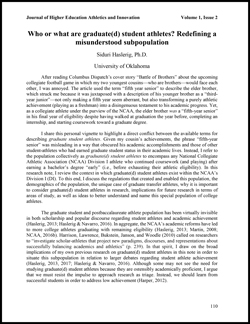 Haslerig, S. J. (2017). Who or what are graduate(d) student athletes? Interpreting a misunderstood subpopulation. Journal of Higher Education Athletics & Innovation, 1(2), 110-122.
.
.
.
.
.
.
.
.
.
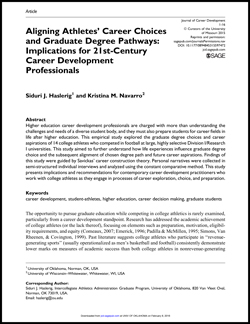 Haslerig, S. J. & Navarro, K. M. (2016). Aligning athletes’ career choices and graduate degree pathways: Implications for 21st century career development professionals. Journal of Career Development, 43(3), 211-226. Doi: 10.1177/0894845315597472
.
.
.
.
.
.
.
.
Dissertation:
 Haslerig, S. (2013). Super seniors: The educational trajectories and experiences of graduate(d) student athletes in division I football (Order No. 3592814). Available from ProQuest Dissertations &Theses Global. (1437228424).
.
.
.
.
.
.
.
.
Selected Presentations:
Haslerig, S. J. & Stevens, K. (January, 2016). Black Graduate Student Athletes: Exploring Their College Experiences and the Possibilities Provided by Graduate Student Status. Paper presented at the 2nd Annual Black Student-Athlete Summit, Austin, TX.
Haslerig, S. (November, 2013). “Get it while it’s free!”: Graduate(d) student athletes’ academic trajectory and meaning-making processes. Paper presented at the Association for the Study of Higher Education (ASHE), St. Louis, MO.
For the sake of clarity, manuscripts are featured under only one heading in this section. The intersecting topics of interest in my scholarship are represented more comprehensively in the diagram immediately below. Alternatively, see my curriculum vitae for a chronological listing.
Equity, Access, & the Experience(s) of People of Color in Higher Education
As a woman of color, diversity, equity, and access are personal concerns, in addition to being central in my work. Most recently, I was second author on an article in AERJ that interrogated how students of color negotiated colorblind rhetoric during college (Vue, Haslerig, & Allen, 2017). Earlier work examined the effect of racial diversity on law students’ in-class experiences and college preparatory models for students of color (Haslerig, et al., 2013; Vue et al., 2012).
Publications:
 Vue, R., Haslerig, S. J., & Allen, W. R. (2017). Affirming race, diversity, and equity through students of color’s lived experiences. American Educational Research Journal, 54(5), 868-903. Doi: 10.3102/0002831217708550
.
.
.
.
.
.
 Haslerig, S., Bernhard, L.M., Fuentes, M.V., Panter, A. T., Daye, C. E. & Allen, W. R. (2013). A compelling interest: Activating the benefits of classroom-level diversity. Journal of Diversity in Higher Education, 6(3), 158-173.
.
.
.
.
.
.
Vue, R., Haslerig, S., Allen, W.R., & Jayakumar, U.M. (2012). Creating college going cultures for Students of Color in the U.S.: Balancing cultural integrity and universal norms. In Living on the Boundaries: Urban Marginality in National and International Contexts (Ed. Yeakey, C. C.) Bristol, England: Emerald Inc.
.
.
.
.
.
Selected Presentations:
Haslerig, S. J., & Edwards, K. T. (April, 2017). Trauma, Violence, and Healing: Diversity Plans as Crisis Management, a Reconceptualization. Paper presented at American Educational Research Association (AERA), San Antonio, TX. [Division J – Postsecondary Education/Division J – Section 6: Society, Culture, and Change]
Burt, B., Garcia, G., Haslerig, S. J., Mwangi, C. G., Stapleton, L., Williams, M. S., & Yao, C. [Alpha.] (November, 2016). Together We’re Stronger: The Making of a Faculty of Color Counterspace. ASHE Council on Ethnic Participation Preconference, Invited Panel.
Intercollegiate Athletics
My research on intercollegiate athletics firmly nests the study of sport within the context of higher education. As a critical scholar, I am concerned with how college sport interacts with college access and students’ college experiences, sometimes creating different (and potentially inequitable) outcomes. My work explores the individual experiences of college athletes and athletic practitioners, as well as more overarching concerns such as the role of college sport symbolically and in popular discourse.
Projects:
GameDay (see above)
Graduate(d) Student Athletes (see above)
Selected Presentations:
Allen, E. L., Haslerig, S. J., & Hextrum, K. M. (November, 2019). On or with? Ethics in qualitative research about college athletes. Presentation at the North American Society for the Sociology of Sport (NASSS), Virginia Beach, VA.
Houston, D. A., Haslerig, S. J., & Bernhard, L. M. (April, 2019). Tweet U: Understanding student-athlete recruiting through a content analysis of tweeted college football offer letters. Roundtable presentation at American Educational Research Association (AERA), Toronto, CAN.
Houston, D. A., & Haslerig, S. J. (November, 2017). What’s Communicated: A Content Analysis of College Football Offer Letters. Paper to be presented at North American Society for the Sociology of Sport (NASSS), Windsor, Ontario, CAN.
Graduate Education
The third stream of my research agenda examines graduate education. Clearly, the research discussed previously on both law students and graduate(d) student athletes intersects with this aspect of my work. Additionally, I collaborated with several emerging scholars on a study of students in Intercollegiate Athletics master’s programs, focusing on participants’ motivations, experiences, and career preparation. A separate, ongoing study interrogates how student-facing practitioners within athletics approach diversity, and what preparation they have received.
Publications:
 Bernhard, L. M., Haslerig, S. J., Navarro, K. M., & Houston, D. A. (2016). Masters of sport: Graduate school pathways of aspiring athletics professionals. Journal of Post-Secondary and Tertiary Education, 1, 85-102.
.
.
.
.
.
.
.
.
 Navarro, K. M., Haslerig, S. J., Bernhard, L. M., Houston, D. A. & Raphael, V. (2016). Best practices in higher education graduate programs: Preparing the next generation of intercollegiate athletics administrators. Journal for the Study of Sport and Athletes in Education, 9(3), 214-231. Doi: 10.1080/19357397.2015.1123003.
.
.
.
.
.
.
.
Selected Presentations:
Bernhard, L. B. & Haslerig, S. J. (April, 2017). Outside of My Realm: Athletic Professionals’ Reflections on Their Preparation for Working With Diverse Students. Paper presented at American Educational Research Association (AERA), San Antonio, TX. [Research Focus on Education & Sport SIG]
Haslerig, S. J. & Bernhard, L.M. (November, 2016). Basic competency: Examining the multicultural competency training needs of athletic professionals. Paper presented at the Association for the Study of Higher Education (ASHE), Columbus, OH.
 Siduri J. Haslerig